


In figures 10 and 11 the numerical solutions
from figures 4 and 5
are plotted together with all of the data results in
figures 6 through 9, on the same graph, for
comparison purposes. Relative phases obtained from temperature data have had the
zero adjusted so that the deep phase is  . Otherwise no fitting has been
done - the numerical results are based entirely on incident solar radiation,
model scattering lengths, and the absorption coefficient for pure ice, as
discussed above.
. Otherwise no fitting has been
done - the numerical results are based entirely on incident solar radiation,
model scattering lengths, and the absorption coefficient for pure ice, as
discussed above.
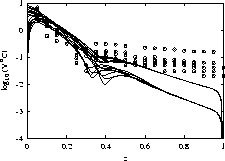
Figure 10: Numerical and data
values of the amplitude of temperature oscillations, plotted
together for comparison. All of the data have been plotted as
circles, and the numerical results as solid lines.
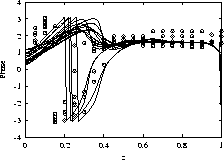
Figure 11: Numerical and data
values of the phase of temperature oscillations, plotted
together for comparison. All of the data have been plotted as
circles, and the numerical results as solid lines.
Phase matches between data and numerical model solutions are
excellent, at all depths. The jumps that can be seen in the phases
are due to restricting phase to principal values between  .
.
Amplitudes also match well in the shallow conductive layer, but the
deep amplitudes are larger (by a factor of  10) in the measured
data than predicted by the model solutions. As noted above, deep
amplitudes are largest after the ice has warmed. Key factors that
might account for the discrepancy are scattering lengths and
absorption coefficients. However, previous studies of the temperature
dependence of scattering lengths in sea ice (Haines and others, 1997)
have shown that the deep scattering lengths are not perceptibly
changed by warming.
10) in the measured
data than predicted by the model solutions. As noted above, deep
amplitudes are largest after the ice has warmed. Key factors that
might account for the discrepancy are scattering lengths and
absorption coefficients. However, previous studies of the temperature
dependence of scattering lengths in sea ice (Haines and others, 1997)
have shown that the deep scattering lengths are not perceptibly
changed by warming.
This suggests that the anomalously high temperature oscillation amplitudes observed at depth may be due to the extra absorption attributable to the presence of algae (Zeebe and others, 1996) or dissolved organic material in the deeper layer (Perovich and others, 1998), since the Monte Carlo simulations we conducted assumed that attenuation of photons was due only to pure ice, between scattering centers. The discrepancy between data and numerical solution amplitudes at depth shows as a deviation in slope on the semilog plot, suggestive of a distributed effect rather than any localised concentration of algae in strata. Grenfell (1991) notes that absorption by algae can reduce transmitted radiation by more than a factor of ten at certain visible wavelengths. Perovich and others (1998) discuss possible mechanisms that could enhance entrapment of organic matter during the slow growth of congelation ice that typifies the deeper sea ice layer, and suggest that an alternative ice growth mechanism such as a sub-ice frazil layer or buoyant anchor ice could bring particles of organic matter to the ice. We would add to this list the possibility of platelet ice also bringing organic matter to be incorporated into the sea ice matrix (e.g., Crocker and Wadhams, 1989; Gow and others, 1998; Jeffries and others, 1993; Smith and others, 1998).
The data presented here represent a direct measurement of the effect of solar radiation penetration in sea ice, and may serve to further inform parametric models of solar heating of sea ice, particularly in light of recent results that emphasise the importance of daily forcing effects (Hanesiak and others, 1999). We plan to explore more fully the changes in deep amplitudes and layer thickness as ice temperature changes, in a future publication. We also plan to take advantage of small parameters that appear in the linearisation (14) and explore the implications of analytic asymptotic solutions for the oscillatory response of sea ice temperature to penetrating solar radiation.