


Thermistor arrays frozen into first-year landfast sea ice in McMurdo Sound in 1996 and 1999 yield hourly temperature measurements at 20 depths spaced 0.1m apart during winter and spring. The chosen locations had little snow accumulation, one about a kilometer off Arrival Heights, and the other in the lee of Big Razorback Island off Cape Evans. The ice in both locations grows to a thickness of more than 2m in winter.
Recorded temperatures are plotted against time in
Figures 1 and 2. Each line of data
corresponds to one thermistor, so that the higher temperatures
correspond to the deeper (warmer) thermistors. The Omega 44031
thermistors used are calibrated and uniform to 0.1  C, but
their potential resolution is
C, but
their potential resolution is  0.001 C. Actual
uncertainty is in practice 0.01 C.
0.001 C. Actual
uncertainty is in practice 0.01 C.
Of some concern is the possibility that the observed temperature oscillations are due to the sun directly heating the thermistor string, rather than being due to variations in ice temperature. The direct heating of the thermistors by sunlight has been modelled in Trodahl and others (2000) and was found to be negligibly small in amplitude. Furthermore it would be in phase with the sun, and this is not observed in our data.
The temperature data show changes forced by variations in air temperature, and also during some periods in spring a smaller faster (daily) oscillation can be seen superimposed on the slower changes, which we assume is due to solar forcing. It is this solar forcing which we investigate further in this paper.
There are periods during spring when no solar forcing is visible - we believe this is when cloud obscures the sun.
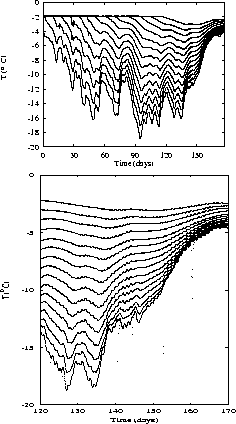
Figure: Temperatures measured in 1996,
plotted against time. Each line is the temperature recorded by one
thermistor at a constant depth. The upper plot
shows temperatures during winter
and spring at depths 0.7-2.0 m, with the coldest
temperatures being from the 0.7 m deep thermistor.
The lower plot shows more detail during spring, and is
for depths 0.5-2.0 m. Day zero is 12 June.
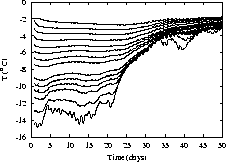
Figure 2: Temperatures measured in the spring of 1999, plotted against time, from
thermistors at depths 0.4-1.9m. Data from 0.6m and 1.1m are
missing, due to faulty thermistors. Day zero
is 14 October.